
Mazda CX-5 Service & Repair Manual: Receiver/Drier Removal/Installation
1. Disconnect the negative battery cable..
2. Discharge the refrigerant..
3. Remove the front under cover No.1..
4. Drain the engine coolant..
5. Remove the following parts:
a. Plug hole plate.
b. Air cleaner, air hose and fresh air duct component.
c. Coolant reserve tank.
d. Cooling fan component.
e. Radiator.
6. Remove the condenser..
7. Disconnect the block joint type pipes by grasping female side of the block with hand holding firmly then loosen the connection bolt A.
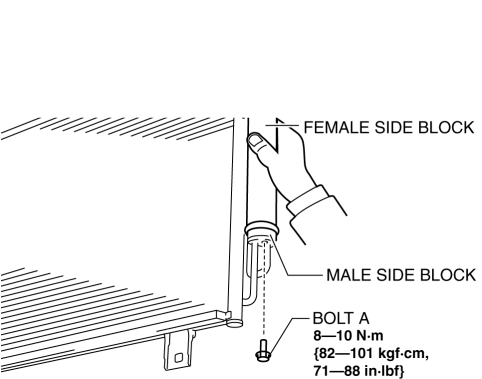
8. Remove bolt B.
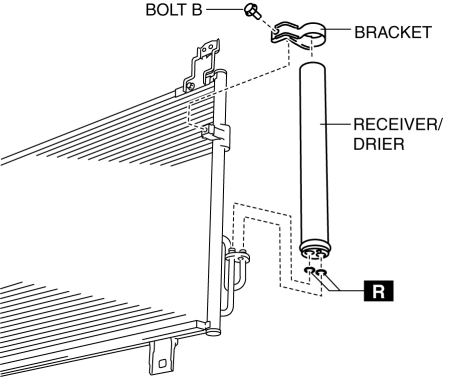
9. Remove the bracket.
10. Remove the receiver/drier. Do not allow compressor oil to spill.
CAUTION:
-
If moisture or foreign material enters the refrigeration cycle, cooling ability will be lowered and abnormal noise will occur. Always immediately plug all open fittings after removing any refrigeration cycle parts to keep moisture or foreign material out of the cycle.
11. Install in the reverse order of removal.
12. Inspect for engine coolant leakage..
13. Perform the refrigerant system performance test..
Receiver/drier Installation Note
1. After replacing the receiver/drier, add compressor oil to the refrigeration cycle.
-
Supplemental oil amount (approx. quantity)
-
2 ml {2 cc, 0.1 fl oz}
 Power Metal Oxide Semiconductor Field Effect Transistor (Power Mos Fet) [Full
Auto Air Conditioner]
Power Metal Oxide Semiconductor Field Effect Transistor (Power Mos Fet) [Full
Auto Air Conditioner]
Purpose
The power MOS FET controls the blower motor rotation speed.
Function
The power MOS FET controls the supply voltage to the blower motor based on
the gate voltage sent fro ...
 Refrigerant Charging
CAUTION:
Do not use a different type of refrigerant or charge beyond the specified
level. Otherwise, cooling ability will be lowered and the A/C compressor could
be damaged.
Chargi ...
Other materials:
Electric Variable Valve Timing Motor/Driver Removal/Installation
WARNING:
A hot engine can cause severe burns. Turn off the engine and wait until it
is cool before servicing.
CAUTION:
Applying excessive force (force of 100 N {10.2 kgf, 22.5 lbf} or more) to
the electric variable valve timing motor/driver may cause a malfunction. When
...
Bumper Bracket Installation [Panel Replacement]
Symbol Mark
Installation Procedure
1. When installing new parts, measure and adjust the body as necessary to conform
with standard dimensions.
2. Drill holes for the plug welding 6 locations indicated by (A) and 3 locations
indicated by (C) shown in the figure, before installing the new ...
Rear Beltline Molding Removal/Installation
CAUTION:
Affix protective tape to the position shown in the figure.
1. Fully open the rear door glass.
2. Insert a tape-wrapped flathead screwdriver and then detach the clip A in the
direction of arrow (1) shown in the figure.
3. Pull up the rear belt line molding in the di ...
