
Mazda CX-5 Service & Repair Manual: Rear Brake (Disc)
Purpose/Function
-
Large diameter, solid-disc type front brakes with a 303 mm {11.9 in} diameter and 10 mm {0.39 in} thickness have been adopted, improving braking force and fade resistance.
Construction
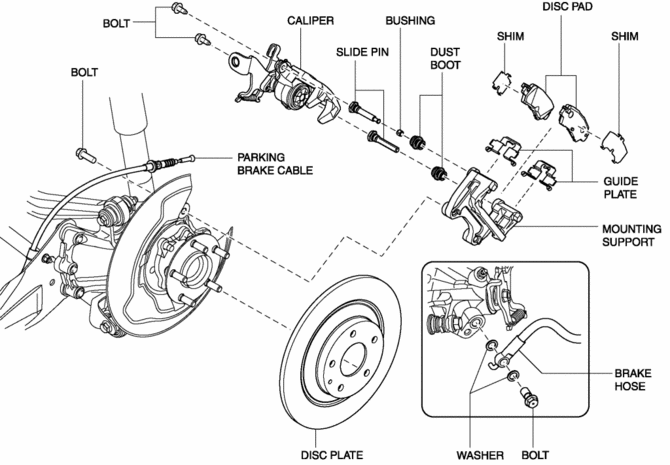
Operation
-
When brake fluid is applied, the piston equipped on one side of the caliper is pushed out and the brake pad is pushed against the disc plate. At the same time, the caliper body moves in the direction opposite of the direction in which the piston is pushed out so as to push the brake pad on the other side and generate brake force.
 Front Brake (Disc) Removal/Installation
1. Remove in the order indicated in the table.
2. Install in the reverse order of removal.
3. After installation, add brake fluid, bleed the air, and inspect for fluid
leakage..
4. Depress the ...
 Rear Brake (Disc) Inspection
Brake Judder Repair Hints
Description
1. Brake judder concern has the following 3 characteristics:
Steering wheel vibration
1. The steering wheel vibrates in the rotation direction. This characte ...
Other materials:
Hydraulic Variable Valve Timing Actuator
Purpose, Function
The hydraulic variable valve timing actuator operates according to the hydraulic
pressure and changes the phases of the exhaust camshaft. As a result, the open/close
period of the exhaust valve is changed, optimized valve timing in accordance
with driving conditions ...
Instrument Cluster
Outline
The instrument cluster centrally controls the speedometer, tachometer, odometer/tachometer,
fuel gauge, warning/indicator lights, trip computer, warning sounds and panel
lights.
Function
The instrument cluster displays the following information to notify the user
...
Rear Wiper Motor Inspection
1. Disconnect the negative battery cable..
2. Open the liftgate.
3. Remove the following parts:
a. Rear wiper arm and blade.
b. Liftgate upper trim.
c. Liftgate side trim.
d. Liftgate recess.
e. Liftgate lower trim.
4. Remove the rear wiper motor connector.
Rear Wiper Motor Ope ...
