
Mazda CX-5 Service & Repair Manual: Quick Release Connector (Emission System)
Purpose, Function
-
Serviceability has been improved by the easy disconnection/connection.
Construction
-
The following types of quick release connectors are used.
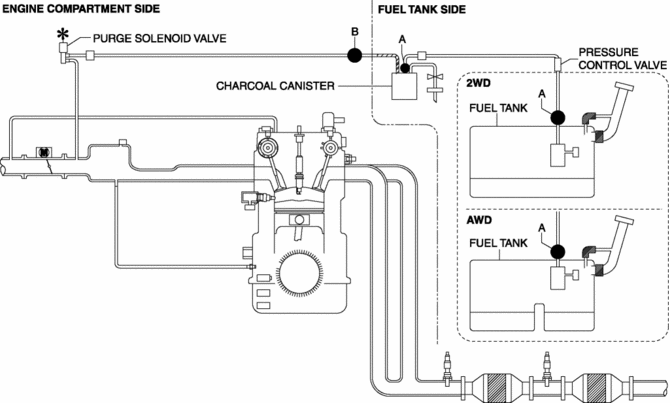
U.S.A. and CANADA
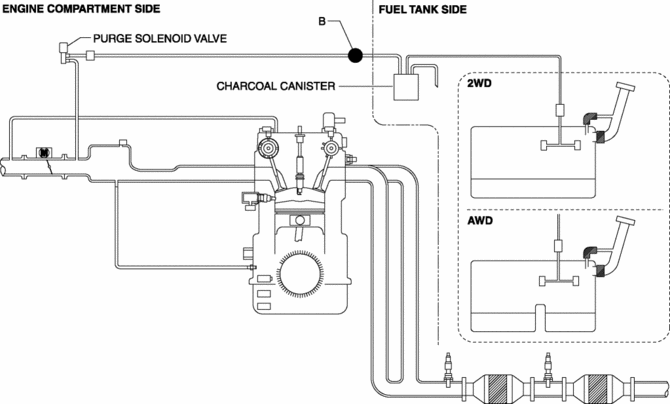
Except U.S.A and CANADA
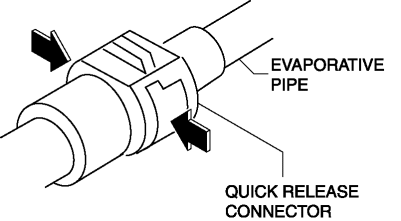
Type A
-
An SST is not used with this type.
-
Consists of a retainer and O-ring. The quick release connector is integrated with the evaporative hose and therefore cannot be disassembled.
-
To connect the quick release connector properly, push it into the evaporative pipe until a click sound is heard.
-
New quick release connectors are fitted with a checker tab that prevent improper installation. This checker tab cannot normally be removed. When the quick release connector is properly connected to the evaporative pipe, the lock is released and the checker tab comes off. Due to this, it can be verified that the quick release connector is completely connected.
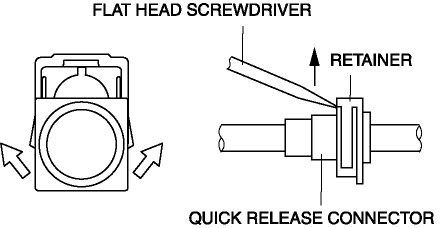
Type B
-
An SST is not used with this type.
-
Mainly consists of a retainer and O-ring. The quick release connector is integrated with the evaporative hose and therefore cannot be disassembled.
-
When the quick release connector is connected, the evaporative pipe projection is locked at the clamp lock point. To release the quick connector lock for each type, follow the procedure in the order shown in each figure.
 Quick Release Connector (Emission System) Removal/Installation
Quick Release Connector Type and Position
CAUTION:
Verify the type and location, and install/remove properly.
U.S.A. and CANADA
Except U.S.A. and CANADA
Type A Removal
CAUTIO ...
 Rollover Valve
Purpose, Function
Prevents fuel from flowing into the evaporative gas passage during sudden
cornering or vehicle rollover.
Construction
The rollover valve is built into the fuel ...
Other materials:
Front Door Glass Removal/Installation
1. Perform the front door glass preparation..
NOTE:
Before removing the front door glass, the removal procedure for the front
door glass installation bolt can be facilitated by adjusting the top of the
front door glass to the position approx. 90 mm {3.5 in} away from the
upper par ...
Disc Pad (Front) Replacement
1. Remove in the order indicated in the table.
2. Install in the reverse order of removal.
3. After installation, depress the brake pedal a few times, rotate the wheel
by hand, and verify that the brake does not drag.
1
Bolt
2
Caliper
...
Interior Equipment (View B)
1 Audio control switches
2 SRS air bags
3 Cruise control switches
4 Navigation system (if equipped)
5 Audio system
6 Hazard warning flasher switch
7 Climate control system
8 Glove compartment
9 Rear window defroster switch
10 Accessory socket
11 MT shift lever
12 AT shift lever ...
