
Mazda CX-5 Service & Repair Manual: Precaution [Dynamic Stability Control (DSC)]
1. The ABS warning light and/or brake system warning light and/or TCS/DSC indicator
light and/or TCS OFF indicator light illuminate even when the system is normal.
|
Warning lights/Indicator lights that may illuminate and/or flash |
Cases in which the light may illuminate |
Conditions in which the light will go out |
ABS, EBD, TCS and DSC control |
|
Only the front wheels rotate under the following condition while jacked up, stuck, or on the chassis dynamometer:
|
After turning off the ignition once and then restarting the engine, the vehicle is driven at 10km/h {6.2 mph} or more , and then normal operation is verified. |
|
|
Parking brake is not fully released while driving. |
|||
|
Brake drag. |
|||
|
Sudden acceleration/deceleration. |
|||
|
Left/right or front/rear tires are different. (Size, radius, tire pressure, or wear is other than that listed on tire label.) |
|||
|
Battery voltage at DSC HU/CM ignition terminal Y drops below about 9.5 V . (*2) |
Battery voltage rises above about 9.5 V . |
|
|
|
Brake system warning light |
Brake fluid amount is low. |
Brake fluid level is with in the specification. |
|
*1 In case where the light may illuminate, only when DSC HU/CM detects that a wheel-speed sensor determines that more than two wheels are malfunctioning.
*2 If battery voltage drops below 10 V
while vehicle speed is greater than 3 km/h {2 mph}
, DSC HU/CM detects DTC U3003:16.
2. Precautions during servicing of DSC. The DSC is composed of electrical and mechanical parts. It is necessary to categorize malfunctions as being either electrical or hydraulic when performing troubleshooting.
a. Malfunction in electrical system
-
The control module has an on-board diagnostic function. With this function, the ABS warning light and/or brake system warning light and/or TCS/DSC indicator light and/or TCS OFF indicator light will come on when there is a problem in the electrical system.
Also, past and present malfunctions are recorded in the control module. This function can find malfunction that do not occur during periodic inspections. Connect the M-MDS (IDS) to the DLC-2. The stored malfunctions will be displayed in the order of occurrence. To find out the causes of DSC malfunction, use these on-board diagnostic results.
-
If a malfunction occurred in the past but is now normal, the cause is likely a temporary poor connection of the harness. The control module usually operates normally. Be careful when searching for the cause of malfunction.
-
After repair, it is necessary to clear the DTC from the control module memory. Also, if the DSC related parts have been replaced, verify that the no DTC has been displayed after repairs.
-
After repairing the ABS wheel-speed sensor or ABS sensor rotor, or after replacing the control module, the ABS warning light may not go off even when the ignition is switched to ON. In this case, drive the vehicle at a speed of more than 10 km/h {6.2 mph}
, make sure the ABS warning light goes off, and then clear the DTC.
-
When repairing, if the DSC related connectors are disconnected and the ignition is switched to ON, the control module will mistakenly detect a fault and record it as a malfunction.
CAUTION:
-
When any DSC HU/CM (brake fluid pressure sensor), SAS control module (yaw rate sensor, low-G sensor) are replaced. Perform the sensor standard point installation of each sensor.
-
-
To protect the control module, make sure the ignition is off before connecting or disconnecting the control module connector.
b. Malfunctions in hydraulic system
-
Symptoms in a hydraulic system malfunction are similar to those in a conventional brake malfunction. However, it is necessary to determine if the malfunction is in a DSC component or the conventional brake system.
-
The hydraulic unit contains delicate mechanical parts. If foreign materials get into the component, the DSC may fail to operate. Also, it will likely become extremely difficult to find the location of the malfunction in the event that the brakes operate but the DSC does not. Make sure foreign materials do not get inside when servicing the DSC (e.g. brake fluid replacement, pipe removal).
Intermittent Concern Troubleshooting
Vibration method
-
If malfunction occurs or becomes worse while driving on a rough road or when engine is vibrating, perform the steps below.
NOTE:
-
There are several reasons why vehicle or engine vibration could cause an electrical malfunction. Some of the things to check for are:
-
Connectors not fully seated.
-
Wire harnesses not having full play.
-
Wires laying across brackets or moving parts.
-
Wires routed too close to hot parts.
-
An improperly routed, improperly clamped, or loose harness can cause wiring to become pinched between parts.
-
The connector joints, points of vibration, and places where wire harnesses pass through the firewall, body panels, etc. are the major areas to be checked.
Inspection method for switch and/or sensor connectors or wires
1. Connect the M-MDS (IDS) to the DLC-2.
2. Switch the ignition to ON (engine off).
NOTE:
-
If the engine starts and runs, perform the following steps at idle.
3. Access PIDs for the switch or sensor you are inspecting.
4. Turn the switch on manually.
5. Slightly shake each connector or wiring harness vertically and horizontally while monitoring the PID.
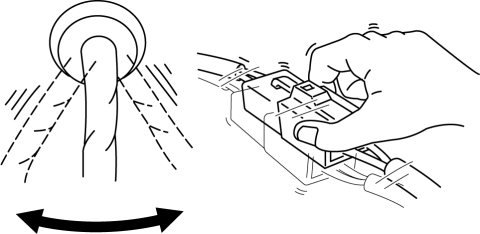
-
If the PID value is unstable, inspect for poor connection.
Inspection method for switches and/or sensors
1. Connect the M-MDS (IDS) to the DLC-2.
2. Switch the ignition to ON (engine off).
NOTE:
-
If engine starts and runs, perform the following steps at idle.
3. Access PIDs for the switch or sensor you are inspecting.
4. Vibrate the sensor slightly with your finger.
-
If PID value is unstable or malfunction occurs, check for poor connection and/or poorly mounted sensor.
Malfunction data monitor method
1. Perform malfunction reappearance test according to malfunction reappearance mode and malfunction data monitor. The malfunction cause is found in the malfunction data.
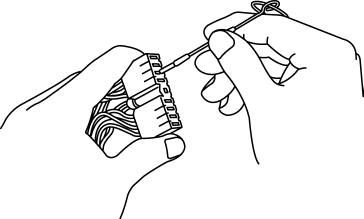
Connector terminal check method
1. Check the connection condition of each female terminal.
2. Insert male terminal; fit female terminal size to female terminal and check to see whether malfunction is in female terminal or not.
 Hill Launch Assist (Hla)
Purpose/Function
The hill launch assist (HLA) is a function which assists the driver in accelerating
the vehicle on a slope by activating the traction control solenoid valve in
the DSC HU ...
 Tcs Control
Outline
The TCS control actuates torque reduction through engine control, as well
as using brake control to control traction.
NOTE:
Engine control: Engine output is lowered by ...
Other materials:
Air Bag System Service Warnings [Standard Deployment Control System]
Air Bag Module Inspection
Inspecting an air bag module using a tester can operate (deploy) the air
bag module, which may cause serious injury. Do not use a tester to inspect an
air bag module. Always use the on-board diagnostic function to diagnose the
air bag module for malfunctions ...
Main Fuse Removal/Installation
1. Disconnect the negative battery cable..
2. Insert a tape-wrapped flathead screwdriver into the service hole in the position
shown in the figure.
3. Move the flathead screwdriver in the direction of the arrow (1) shown in the
figure, pull up the main fuse cover in the direction of the ...
Differential Oil Replacement
1. Place the vehicle on level ground.
2. Remove the filler plug.
3. Remove the drain plug and drain the differential oil into a container.
4. Install a new washer and the drain plug, and tighten.
Tightening torque
40—53 N·m {4.1—5.4 kgf·m, 30—39 ft·lbf}
5. Add the ...
