
Mazda CX-5 Service & Repair Manual: Master Cylinder
Purpose/Function
-
With the adoption of the master cylinder having an enlarged diameter (20.64 mm {0.8126 in}), brake pedal operability has been improved.
-
For vehicles with DSC, the diameter of the pipe between the master cylinder and the DSC HU/CM has been increased, improving response during DSC operation.
Construction
-
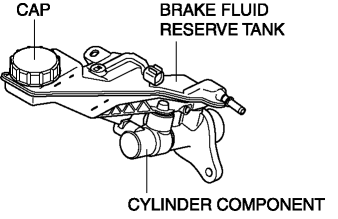
Except for the cap and brake fluid reserve tank, the master cylinder cannot be disassembled. Therefore, if there is any malfunction in the interior of the master cylinder, replace the cylinder component without disassembling.
Operation
-
When the brake pedal is depressed, the push rod of the power brake unit presses in the master cylinder piston. By pressing in the piston, pressure is applied to the brake fluid to operate the brakes.
 Master Cylinder
Purpose/Function
With the adoption of the master cylinder having an enlarged diameter (20.64
mm {0.8126 in}), brake pedal operability has been improved.
For vehicles with DSC, the di ...
 Master Cylinder Removal/Installation
1. Remove the battery..
2. Remove in the order indicated in the table.
3. Install in the reverse order of removal.
4. After installation, add brake fluid, bleed the air, and inspect for fluid
...
Other materials:
Seat Belt Warning Alarm
Purpose
The seat belt warning alarm warns occupants that a seat belt is not fastened.
Function
The instrument cluster sounds the seat belt warning alarm based on the following
CAN signals:
Vehicle speed signal sent from PCM
Driver/passenger buckle switc ...
Main Fuse
Purpose
If electric current of the specified value or more flows to each fuse, the
fuse melts due to heat generation to protect the systems and parts downstream
of the fuse.
Function
If electric current to each fuse is the specified value or more, the fuse
melts due to h ...
Bsm Indicator Light Flashes While Not Under Bsm Indicator Light Flashing Conditions
(No Combination Switch Operation (Turn Signal Switch)) [Blind Spot Monitoring (Bsm)]
Description
BSM indicator light flashes while not under BSM indicator light-flashing
conditions (no combination switch operation (turn signal switch)
The BSM indicator light flashes despite not satisfying the BSM indicator
light flashing ...
