
Mazda CX-5 Service & Repair Manual: Generator Control [Skyactiv G 2.0]
Outline
-
Idling stability has been improved by optimum control of generator voltage according to engine operation and electrical load conditions.
-
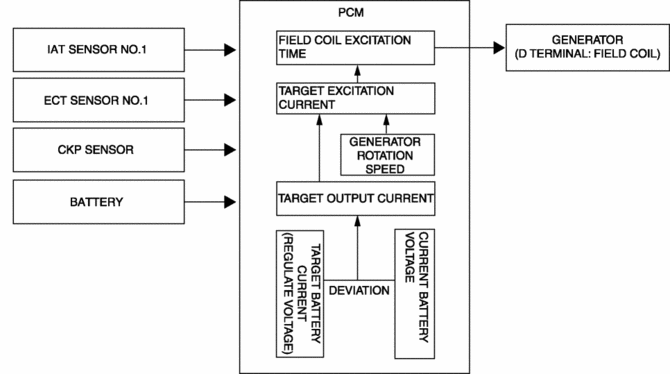
The PCM determines the engine operation and electrical load conditions based on the input signals from each control part and controls the energization time of the generator field coils.
Block Diagram
Operation
Determination method for target excitation current
-
The target excitation current is calculated from the generator target output amount (determined by intake air temperature, engine speed, and vehicle speed), and the actual generator rotation speed.
Determination method for field coil excitation time
-
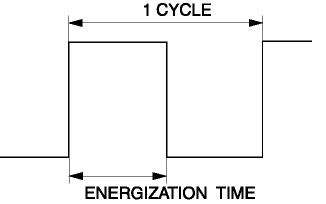
The PCM increases or decreases the field coil excitation current by sending a duty signal to the power transistor built into the generator.
-
The field coil energization current changes according to changes in the power transistor excitation time by changing the duty signal duty ratio. For example, when the battery positive voltage drops, the duty ratio of the duty signal sent to the power transistor is larger, increasing the field coil excitation current.
-
During deceleration fuel-cut, the PCM increases the generator voltage and stores electricity in the battery. At times other than deceleration, the PCM enables electric discharge from the battery to reduce the generator load.
-
Directly after the engine is started, the generator load is decreased by charging only to the necessary level according to the battery conditions in which the battery has not been charged to the maximum.
 Charging System [Skyactiv G 2.0]
Outline
Regulator-less generator (built-in power transistor) has been adopted.
A generator using two delta connection type stator coils has been adopted.
Structural View
Stru ...
 Generator Disassembly/Assembly [Skyactiv G 2.0]
CAUTION:
Melt the solder quickly, otherwise the diodes (rectifier) and regulator will
be damaged by excessive heat.
1. Disassemble in the order indicated in the table.
2. Assemble i ...
Other materials:
Keyless Antenna Removal/Installation
With Advanced Keyless Entry System
Vehicle interior, front
1. Disconnect the negative battery cable..
2. Remove the following parts:
a. Decoration panel.
b. Shift lever knob (MTX).
c. Front console box.
d. Shift panel.
e. Upper panel.
f. Rear console.
g. Side wall.
h. Front conso ...
Brake Hose (Rear) Removal/Installation
1. Remove in the order indicated in the table.
2. Install in the reverse order of removal.
3. After installation, add brake fluid, bleed the air, and inspect for fluid
leakage..
1
Brake pipe
2
Clip
3
Bolt
...
Crankshaft Position (CKP) Sensor
Purpose/Function
Detects the crankshaft speed as basic information for mainly determining
the fuel injection timing and ignition timing.
Detects the crankshaft speed and inputs it to the PCM as a CKP signal.
Construction
Installed on the side of the cylinder block (ri ...
