
Mazda CX-5 Service & Repair Manual: Expansion Valve Removal/Installation
1. Disconnect the negative battery cable..
2. Discharge the refrigerant from the system..
CAUTION:
-
If moisture or foreign material enters the refrigeration cycle, cooling ability will be lowered and abnormal noise will occur. Always immediately plug all open fittings after removing any refrigeration cycle parts to keep moisture or foreign material out of the cycle.
3. Remove the nut.
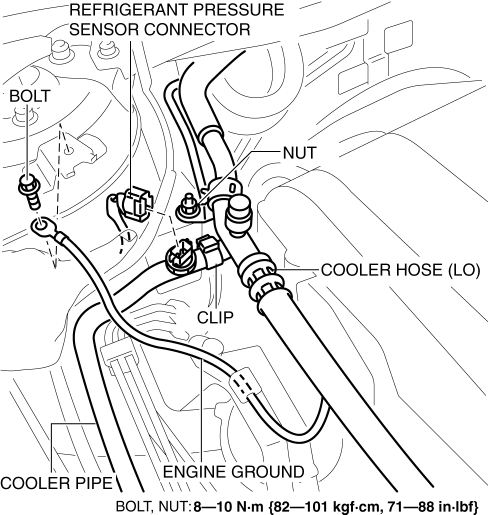
4. Remove the clip.
5. Disconnect the refrigerant pressure sensor connector.
6. Disconnect the engine ground.
7. Remove the bolt and disconnect the cooler hose (LO) and cooler pipe. Do not allow compressor oil to spill.
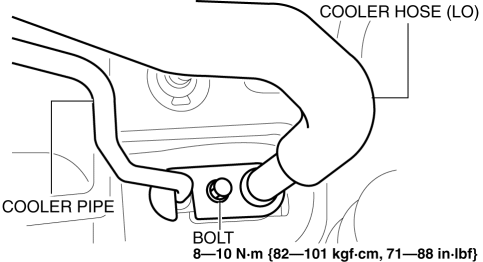
8. Set the cooler hose (LO) and cooler pipe aside as shown in the figure while being careful not to let remaining oil in the pipes to spill.
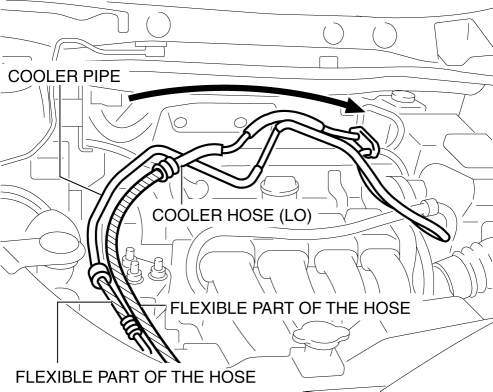
CAUTION:
-
When setting the cooler hose (LO) and cooler pipe aside, only bend the flexible part of the hose. If force is applied to areas other than the flexible hose, the pipe will bend and could be damaged.
9. Remove the bolt.
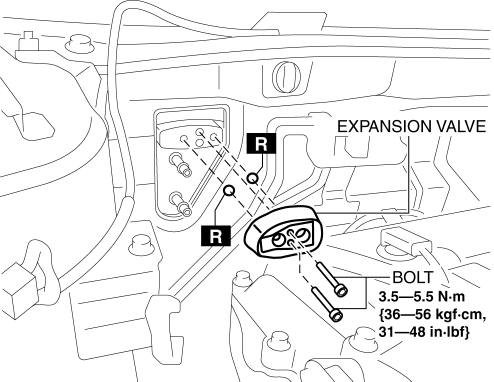
10. Remove the expansion valve. Do not allow compressor oil to spill.
11. Install in the reverse order of removal.
12. Perform the refrigerant system performance test..
 Expansion Valve
Purpose
The expansion valve atomizes liquid refrigerant to facilitate cooling of
the evaporator.
Function
The expansion valve reduces the pressure of liquid refrigerant rapidly ...
 Fan Switch Inspection [Manual Air Conditioner]
1. Disconnect the negative battery cable..
2. Remove the following parts:
a. Shift lever knob (MTX).
b. Glove compartment.
c. Front console box.
d. Shift panel.
e. Upper panel.
f. Rear c ...
Other materials:
Exhaust Manifold
Purpose, Function
By lengthening the exhaust passage, the transmission of exhaust pressure
waves to other cylinders can be delayed, and the amount of gas exhausted from
a cylinder and forced back inside the combustion chamber is reduced By reducing
the residual gas, the temperature i ...
Miller Cycle Engine
Outline
The Miller cycle engine is a high-efficiency engine which achieves high fuel
economy performance by obtaining a high-expansion ratio.
The Miller cycle engine achieves a high-expansion ratio without increasing
its effective compression ratio by retarding the intake air va ...
Lap Pre Tensioner Seat Belt [Two Step Deployment Control System]
Purpose
The lap pre-tensioner seat belts retract and tighten the seat belt webbing
to protect the front passengers during a collision.
Function
The lap pre-tensioner seat belts operate (deploy) based on the operation
signal from the SAS control module to instantly retract a ...
