
Mazda CX-5 Service & Repair Manual: Cylinder Head
Outline
-
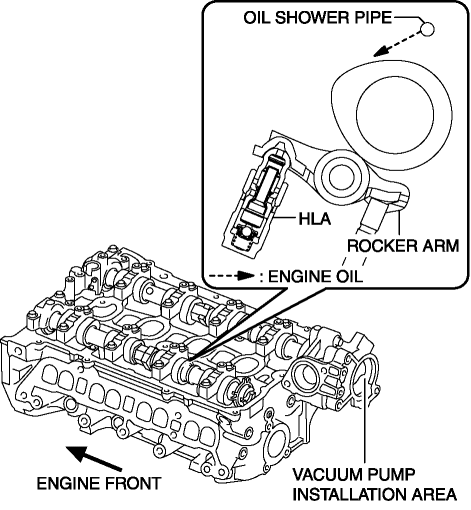
With the adoption of the rocker arm (built into needle roller bearing), the sliding resistance has been reduced.
-
With the adoption of the HLA, the valve clearance is maintained at 0 mm at all the times.
-
The contact point of the rocker arm and cam is lubricated by the engine oil injected from the oil shower pipe.
-
Because the SKYACTIV-G 2.0 is implemented on the Miller cycle, the intake manifold vacuum is insufficient during the intake valve opening timing. To improve this, the intake manifold vacuum insufficiency is supplemented with the adoption of the vacuum pump..
Purpose, Function
-
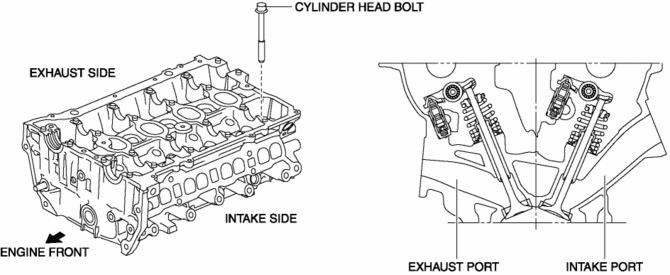
The cylinder head forms the combustion chamber and intake and exhaust ports.
Construction
-
The lightweight cylinder head is made of aluminum alloy with excellent thermal conductivity.
-
Designing a compact pentroof combustion chamber and positioning the spark plugs on the top of the combustion chamber has improved the combustion efficiency.
-
There are two intake valves and two exhaust valves per cylinder for a total of four valves and the intake/exhaust type has been changed to a cross-flow type, improving intake and exhaust efficiency.
-
High pressurization is achieved by optimizing the intake port shape, improving the tumble ratio, increasing the combustion speed, and suppressing knocking.
-
With the adoption of plastic region tightening* for the cylinder head bolts, axial force has been stabilized.
 Cylinder Head Gasket
Purpose, Function
The cylinder head gasket is installed between the cylinder head and cylinder
block to prevent leakage of air-fuel mixture, combustion gas, engine oil, and
engine coolant ...
 Hydraulic Lash Adjuster (Hla) Inspection
HLA Troubleshooting
Item
Occurrence
Possible cause
Action
1
After replacing oil, sound occurs when starting engine
...
Other materials:
Shift And Select Mechanism [C66 M R]
Purpose, Function
The shift and select mechanism moves the shift fork to change gears according
to the operation of the shift lever in the cabin.
Construction
Shift control module
The moving parts of the shift control module are vertically positioned..
In th ...
Differential Oil Temperature Sensor
Purpose, Function
The differential oil temperature sensor detects the rear differential oil
temperature based on the resistance of the thermistor, and inputs it to the
AWD CM.
Construction
The differential oil temperature sensor is installed in the rear differential
carr ...
Cruise Set Indicator Light (Green)
Purpose/Function
Illuminates during the cruise control system operation to inform the driver
that the cruise control system is operating.
Construction
Built into the instrument cluster.
Operation
Illuminates during the cruise control system operation.
...
